AI Commerce Automations · AI Product Descriptions
AI product descriptions
We build AI workflows that write product descriptions at catalog scale, inside your admin, with a human approving before anything publishes. In our example build, 12,000 SKU got described in three languages and the content team got 58 hours a month back.



What are AI product description workflows?
An AI description workflow is not a chat window someone pastes products into. It is a pipeline inside the platform: the product’s attributes go in, your encoded brand voice and category structures shape the text, and a human review gate decides what gets published.
The difference shows at scale. A generic tool drifts off-brand within a hundred SKU; a workflow keeps terminology aligned with your filters, structure aligned with SEO, and learns from every correction your reviewers make.
The three numbers content workflows work for
Catalog content is an industrial process. These are its gauges.
Catalog coverage
100%
Every SKU with a full description, attributes and SEO, including the long tail no copywriter ever reaches.
Time per description
min
A batch of a hundred descriptions takes hours with human review, not weeks in an agency queue.
Approved unedited
%
The workflow learns from every reviewer correction; the share published without changes grows batch by batch.
AI workflows in the platform or copywriting on order?
Hero products deserve a human writer. The other four thousand SKU deserve a process.
Flagship hero products still deserve a human writer. The workflow takes the long tail and the daily grind off your team.
AI Product Descriptions
Catalog content is a volume problem, treat it like one
At ten products, descriptions are copywriting. At ten thousand, they are an industrial process: consistency across categories, terminology that matches your filters, structure that feeds SEO and channel requirements. Human teams cannot scale that process, and generic AI tools break it differently, drifting off-brand within a hundred SKU.
Workflows are the middle path: your tone, structures and banned phrases encoded once, generation running inside the platform where products live, and a review gate that keeps a human’s name on every publication. The result reads like your best writer on their best day, at catalog scale.
What we deliver
Content pipeline
4 batchesHow we do it
A content workflow rollout, week by week
Automation projects move faster than platform builds: a working pilot lands in weeks, not months.
Week 0
Content Blueprint
Audit of current descriptions, brand voice and banned phrases encoded, structures per category, quality metrics agreed.
Weeks 1–2
Engine and rules
The workflow wired into your platform: attribute inputs, generation rules, the review queue.
Week 3
Pilot category
Real SKU in batches through the review gate; quality measured by unedited-approval rate, not vibes.
Weeks 4–5
Scale and languages
Rollout across categories, translation variants, per-channel content lengths.
Week 6
Hand-off
Reporting on coverage, hours saved and edit rates; further tuning inside Maintenance & Growth.
Who content workflows are for, and who they are not for
A good fit when
- Catalogs of hundreds or thousands of SKU with gaps and inconsistent descriptions
- Expansion into new languages or channels where content is the bottleneck
- A content team drowning in routine while hero content waits
A poor fit when
- A few dozen products; writing by hand is cheaper than any setup
- There is no product data to generate from; attributes come first, the workflow does not invent facts
- Publishing without any human review from day one; trust is earned batch by batch
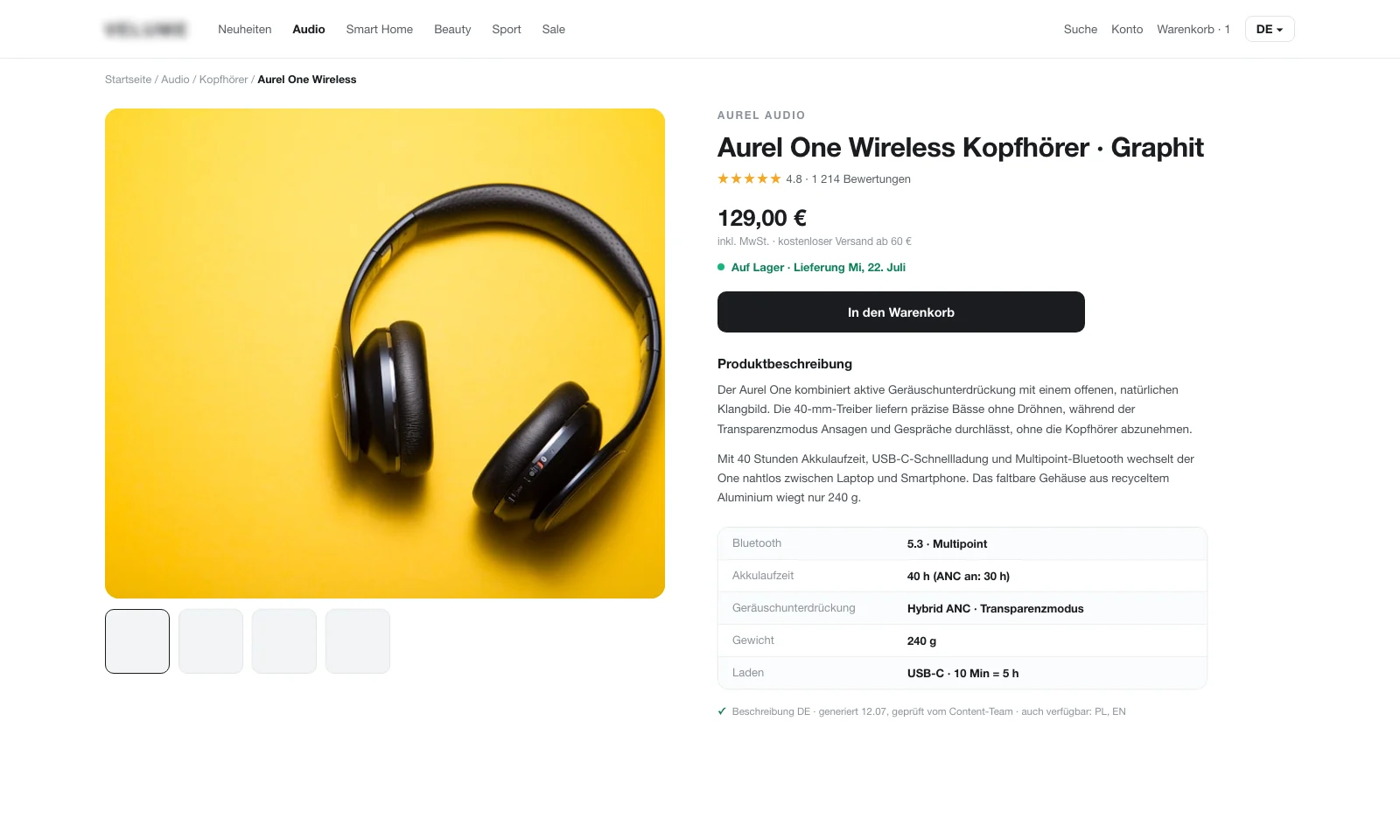 See it in practice12,000 SKU described by workflows, approved by people12,000 · sku covered in 3 languages
FAQ
AI product descriptions
What unedited-approval rate is realistic?
After the tuning pilot, most batches publish with only a small fraction edited, the workflow learns from every correction your reviewers make.
Can it write category and collection pages too?
Yes, the same engine covers category intros, collection copy and buying-guide blocks, which quietly become your strongest SEO surface.
Will the descriptions sound like AI?
The workflow encodes your tone, structure and vocabulary, and a person approves each batch. In practice reviewers edit a fraction of outputs, the rest publish as-is.
Does AI content hurt SEO?
Thin, duplicated content hurts SEO, human-reviewed, attribute-rich descriptions help it. That is why the quality gate is non-negotiable in our builds.
How is this priced?
Per workflow: a fixed setup for the description workflow, then it runs inside your platform. You add more workflows only when this one has paid back.
Does Google penalise AI-generated content?
Google evaluates whether content is helpful, not how it was produced. Descriptions generated from real product data and reviewed by a human meet the guidelines; what gets penalised is mass-produced filler with no value.
Which AI models do you use?
Claude and other frontier models, chosen per workflow and language rather than by ideology. The model is a component; the rules, the data and the review process make quality repeatable.
Will descriptions differ between our store and marketplaces?
Yes. Channel variants come from the same source: different length, structure and keyword focus for the store, Amazon or Kaufland, as part of the mapping.